

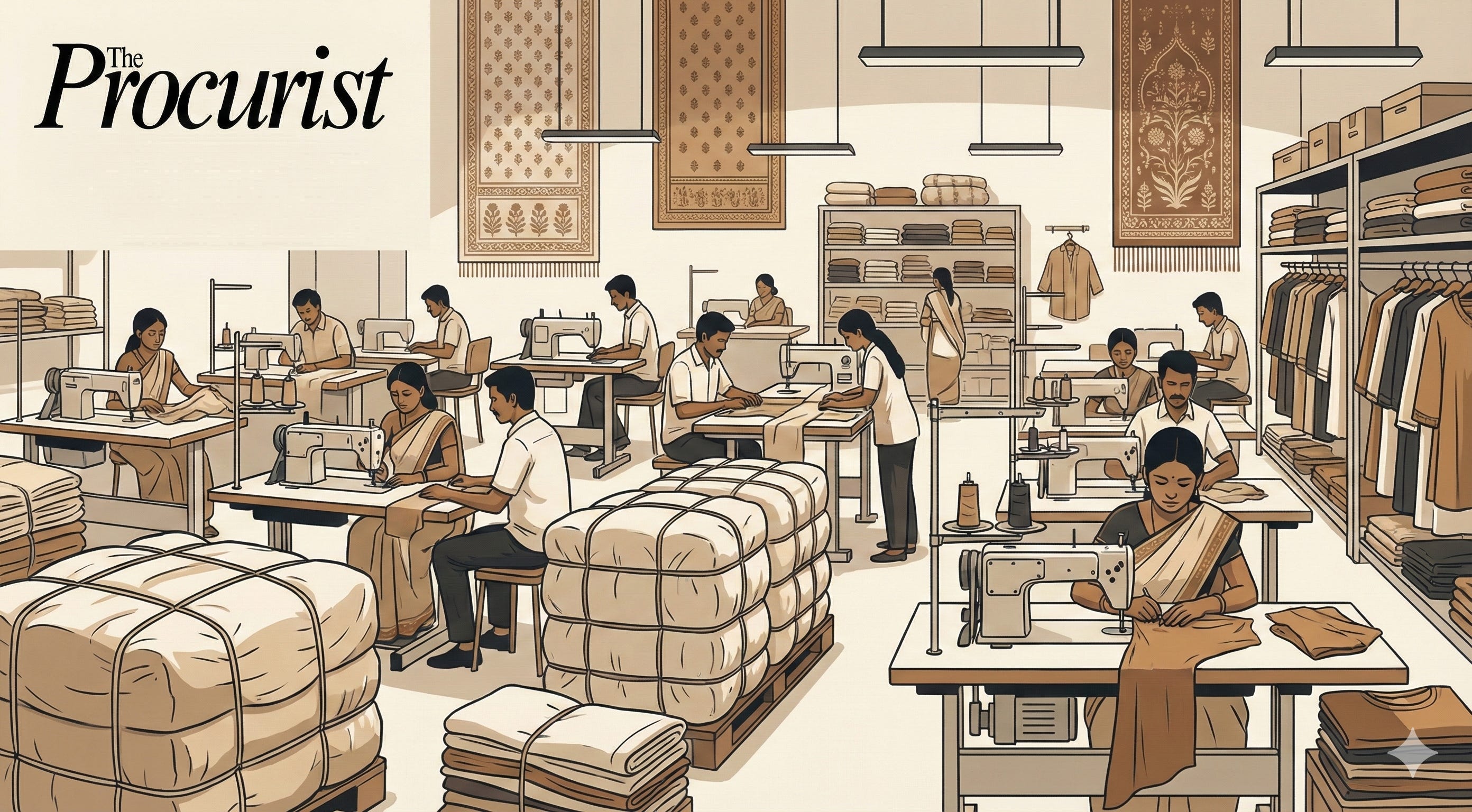
The global apparel industry stands at an inflection point. Tariff wars have thrown sourcing strategies into disarray. Bangladesh faces prolonged instability. China increasingly makes products for Chinese consumers, not Western brands. And one country, long considered an underperformer, appears ready to claim the spotlight.
“I think the big winner is going to be India,” says Michael Bennett, a British sourcing executive who has spent three decades building supply chains across Asia for brands including Decathlon, Puma, and Champion. “India has not fulfilled its potential over the last 10 or 20 years. I think today is going to have its day in the sun.”
Bennett’s assessment carries weight. He opened Decathlon’s India office in 1998, hiring staff through a newspaper ad in the Times of India. Three hundred candidates showed up that first Saturday morning. Some of those original hires still work for Decathlon India today, now in senior leadership roles.
His prediction about India reflects broader shifts in how apparel brands think about where to make their products. The calculus has changed. Speed matters more. Relationships matter differently. And the old model of chasing the lowest labor cost no longer works.
The Tariff Response Varies Wildly
Every company is handling tariff uncertainty differently, and the range of responses reveals deeper strategic divisions within the industry.
Some brands have chosen patience, waiting to see how trade policy evolves before making major moves. Others went straight to their suppliers and demanded discounts to offset new costs. That approach, Bennett suggests, damages long-term relationships that took years to build.
“I’d rather not hit the suppliers with discounts,” Bennett says. “I’d rather look for opportunities to find value.”
The smarter brands are working with their manufacturing partners to find efficiencies, not simply passing along pain. Suppliers often know where costs can come out of a product or process. They will share that knowledge with brands they trust. They will not share it with brands that squeeze them at the first sign of trouble.
The most sophisticated operators have built what Bennett calls “centralized design and development” models. Product creation happens in one location. Manufacturing shifts to wherever makes strategic sense, whether that means Latin America for U.S.-bound goods or Africa for European markets. This structure allows brands to respond to tariff changes without starting from scratch each time.
What Store Experience Teaches Sourcing Professionals
Bennett started his career working the floor at a Decathlon retail store in France. He stocked shelves. He moved boxes. He watched customers touch products and make buying decisions.
That experience shapes how he thinks about supply chains today.
“You really only get those insights if you’re actually working and moving the boxes and putting the product on the shelf,” Bennett says. “I would really encourage anybody who wants to go into sourcing to get some experience of the front end as well.”
The lesson extends beyond customer preferences. Working in a store reveals how small upstream decisions create downstream problems. The placement of a label. How a garment gets folded. The quality of a shipping box. These details determine whether a retail operation runs smoothly or struggles with inefficiency.
Most sourcing professionals never see this. They work in offices thousands of miles from where products get sold. The disconnect creates blind spots.
The Hand Feel Problem
At Coach, where Bennett spent five years, product development meetings sometimes involved executives staring into space while running their fingers across leather samples. To an outsider, it looked absurd. To anyone who understood the business, it made perfect sense.
“The hand feel of getting the right smoothness, the right give in the leather, how you built that and then how you can replicate it 100,000 or 200,000 times was absolutely essential,” Bennett says.
This challenge exists across apparel categories. Champion obsessed over the feel of its t-shirts and sweatshirts. Athletic footwear brands employ chemists to develop materials that perform at elite levels. Getting the product right requires coordination among tanners, textile engineers, production managers, and designers.
The hard part comes after development. A craftsman in a sample room can produce a beautiful garment. Making that same garment at scale, with consistent quality, demands industrial discipline.
“How do you replicate something lovingly made in a tailor shop a couple hundred thousand times?” Bennett asks. “That’s an interesting problem to solve.”
Sustainability Became Standard Practice
The sustainability conversation has shifted. What once required dedicated initiatives and special programs now sits at the core of how factories operate.
“It’s just become part of doing business,” Bennett says. “It’s just another facet of doing business today.”
Factories have improved dramatically on both social and environmental compliance. The ground has shifted. But problems remain.
Brands often fail to understand how their own decisions create compliance issues at factories. Changing delivery dates. Swapping materials at the last minute. Negotiating prices down to margins that force corner-cutting. These actions happen in corporate offices. The consequences show up on factory floors.
“I think the brands and retailers do not to a great extent understand the impact of their actions,” Bennett says.
Factories hesitate to raise these issues. They fear losing business if they push back or disclose problems, even when those problems stem from brand decisions. Trust remains low. Transparency suffers as a result.
The industry tried to address audit fatigue through standardized compliance programs. Bennett worked on the Social and Labor Convergence Program, which aimed to reduce duplicative factory audits. The problem has gotten worse, not better. Factories serving multiple brands face constant audit disruptions as each customer demands its own verification process.
The 18-Month Lead Time Trap
Apparel supply chains remain remarkably inefficient. Lead times from concept to delivery can stretch 18 months. Much of that time involves waiting.
“So much of that is just waiting time, waiting for somebody to approve something so it can go to the next step,” Bennett says.
Technology promised to fix this. The industry has invested in 3D development tools, collaborative platforms, and data-sharing systems. Yet Bennett’s inbox stays full of emails and Excel spreadsheets. Late-night calls include dozens of participants, many adding a single word just to show they were present.
The technology exists to work differently. Adoption lags. Change management proves harder than software implementation.
“If your job is to sit in the head office and approve lab dips, then obviously you’re not going to be too interested if you can do it digitally or if the vendor does it,” Bennett says. “A lot of this is change management.”
Long lead times create waste. Brands commit to volumes, colors, and styles far in advance. When forecasts miss, inventory piles up or stockouts occur. The industry builds inefficiency into its operating model, then wonders why margins stay thin.
Building in New Markets Takes Patience
Opening a sourcing office in a new country sounds straightforward. Find factories. Start buying. Scale up.
Reality works differently. When Bennett set up Decathlon’s India operation in 1998, he faced a different world. No internet. Paper documentation. Government offices that required endless stamps and signatures. Backup generators because power failed regularly. Water systems independent of unreliable municipal supply.
The practical challenges have eased. The strategic ones remain.
“The key is to keep focus,” Bennett says. “Have a strategy of what you actually want to find and what you’re looking for, and then stick to it.”
Decathlon started with knitted garments in South India and equestrian equipment in the north. Only after those categories ran smoothly did the company expand into bicycles and footwear. Patience paid off. The factories developed. The relationships deepened. The business grew.
Companies driven by quarterly earnings struggle with this approach. Their attention spans run shorter than supply chain development timelines require.
What Comes Next
The apparel sourcing map will look different in five years. India appears positioned to gain share. Latin American production will grow for U.S.-focused brands. China will continue its pivot toward domestic consumption.
The winners will be brands that maintained supplier relationships through the tariff chaos rather than those that squeezed partners for short-term savings. They will be companies that invested in understanding their full supply chains, from raw materials through retail shelves. They will be organizations that finally addressed the technology and process gaps that keep lead times unnecessarily long.
The opportunity exists. Capturing it requires patience that many companies have lost.
This article is based on a video interview from The Sourcing Exchange. Watch the full conversation here
Continue the discussion on Chain.NET (www.chain.net).