

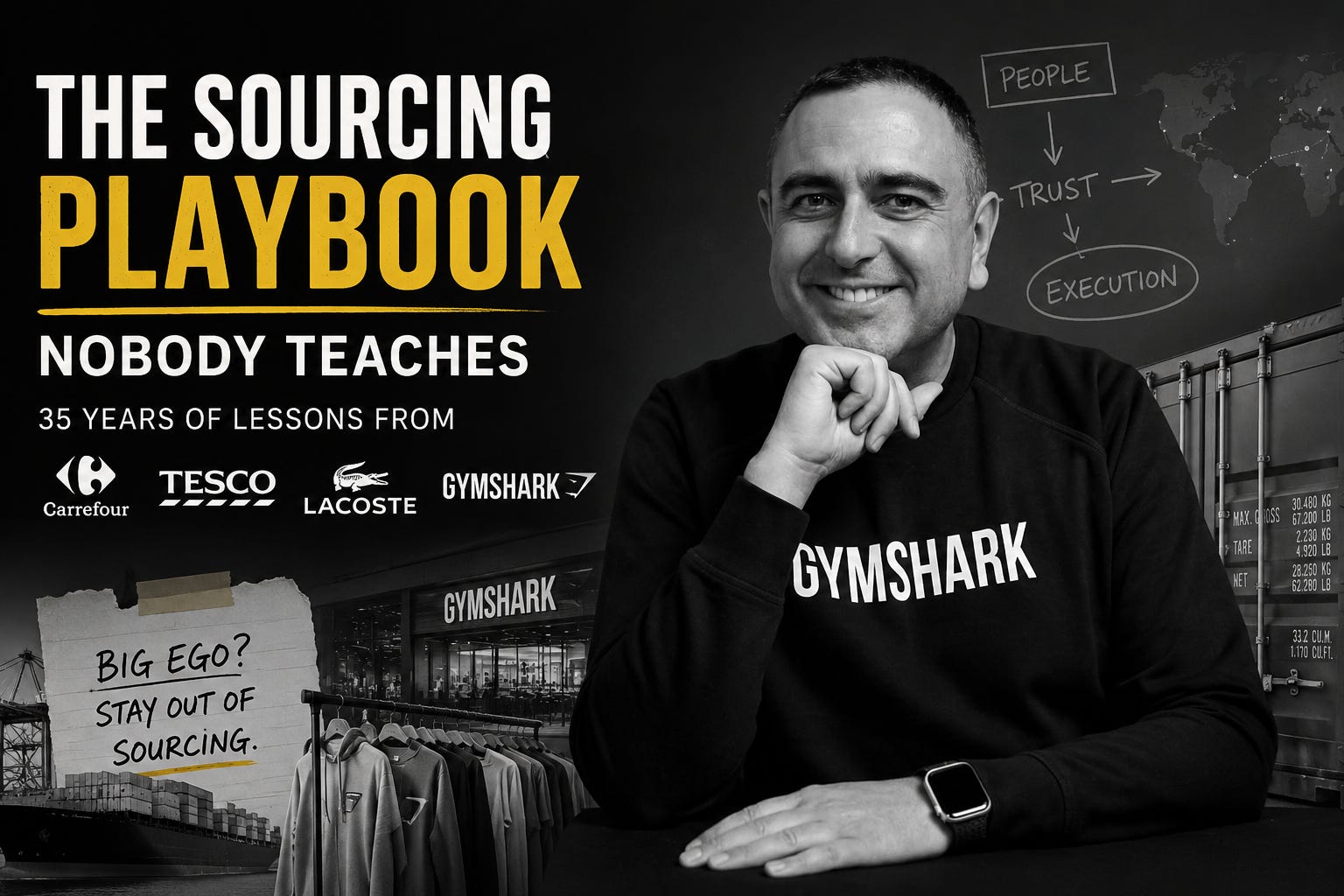
There is no university course for sourcing executives. You can study buying, product management, or marketing. You cannot study how to build a factory network across four continents, absorb an overnight tariff shock, and keep 10 suppliers investing in your brand at the same time.
That gap is one reason the path to the top of sourcing looks different for everyone who gets there. Laurent Madelaine, Chief Product and Supply Chain Officer at Gymshark, started his on a Carrefour shop floor. Thirty-five years later, after building Carrefour’s Bangladesh sourcing office from scratch in 2001, running clothing and footwear sourcing for Tesco from Hong Kong, and leading end-to-end operations at Lacoste, he has a clear view of what separates the brands that get sourcing right from the ones that treat it as a cost line.
Start by walking in someone else’s shoes
Madelaine’s early career spanned stores, buying, and merchandising before he ever touched sourcing. He credits that range for much of what came later. When he landed in Bangladesh, he knew exactly what buyers wanted and where the gaps were, which mattered in a country no one at head office had worked in.
His framing of the role is direct. Sourcing is a service function for the rest of the business, even while it shapes strategy. Supply chain is a chain, a group of people who work together and hand over to each other. Losing sight of that turns the function into a bottleneck instead of an enabler.
Partnership means standards plus emotional attachment
Ask Madelaine what world-class supplier partnership means and he splits it in two.
The first half is standards. You need world-class manufacturers and industry specialists who can go deep on materials and technology, operating state-of-the-art factories. Size is not the issue. Doing it the right way, with real investment and real passion, is. Where a supplier falls short, you either help them reach the benchmark or you raise your expectations.
The second half is harder to systematize. You need emotional attachment to your brand. That means the supplier matters to you and you matter to them. At Lacoste, he ran supplier conferences during the French Open in Paris. At Gymshark, suppliers get invited to the Lift event. The point is not to review quality standards. It is to let suppliers see the brand, the community, and the customer, then explain what the business wants to do next.
The commercial logic is straightforward. If you do this well, suppliers want to invest in your business. Ten partners each investing a million dollars a year gives you ten million dollars of investment and a competitive advantage that is hard to copy.
The traffic runs both ways. Madelaine takes CEOs, buyers, marketing, and merchandising colleagues to visit factories. They take ownership of the relationship and they communicate the brand better afterward.
Partnership is not friendship
He is blunt about the limits. Partnership does not mean friendship. It is business. As a brand, you feed the supplier with volume. Growth brands find partnership easier to build because they invest to do better and to do more. Suppliers commit because you bring business, create jobs, and improve their margins, not because the meetings are pleasant.
What sustains it is consistency. Do what you said. Change plans or send mixed signals and trust erodes fast. He recalls telling suppliers directly that his planning was not accurate during a period of rebuilding. Suppliers can work with that. What they cannot work with is discovering a problem nobody mentioned.
Consistency has to hold across the team too. If the sourcing executive says one thing and the buyer says another, the strategy collapses on contact.
De-risking is the whole job now
On risk, Madelaine’s philosophy starts with end-to-end thinking. Fiber, material, trims, everything. You cannot produce a garment if you are missing a zip, a yarn, or a dye.
He rejects the idea that disruption is new. Early in his career, anti-dumping actions and embargoes hit overnight, and the postponed end of the China quota system left goods floating and unreleasable at customs. What has changed is the ability to anticipate. Being on the ground used to give you warning. Now you can wake up to 100% duty and see it reset to zero the next day.
His recent example: when the United States announced new duties and Vietnamese product faced a sharp increase, his team kept calm, assessed the situation, got the right people around the table, and modeled scenarios. Because some of their sourcing sat in countries that were duty-free to the US and then faced only the 10% minimum, they shifted volume from the Middle East to Asia and from Asia back the other way. The result was a US supply base distinct from the European one.
His verdict on the wait-and-see camp is nuanced. You work on the plan and wait. Rushing overnight is never good when stock sits in your DC, on the water, and in production. But waiting while doing nothing is not a strategy. Know your options and measure what you can absorb financially.
AI: own the process first
Madelaine sees AI moving fast in Asian factories, including fabric defect detection, and encourages suppliers to invest. For brands, his advice is sequenced. Know your process properly. Identify which parts are genuinely painful. Then apply AI where it brings accuracy and speed, which flows through to cost.
He points to critical path management, container consolidation, and costing as strong candidates. Instead of people typing into spreadsheets, resource shifts to development and innovation. His caution is about ownership. You cannot delegate a process you do not understand to a machine, and you need to protect the know-how that forms your brand’s DNA.
Takeaways for sourcing leaders
Hire for curiosity, not just technique. Madelaine says technique can be learned. What cannot be taught easily is the willingness to travel, to check assumptions, and to accept that what was true five years ago is false today. He nearly missed Morocco’s revival because he assumed the industry had not moved. A younger generation had rebuilt it and was running fast-turnaround programs for Zara.
Talk about what you have seen, not what you think. A Tesco boss taught him to go to the right level of detail to find the truth. If you have not been in the factory, you do not know.
Nearshoring is a tool, not a doctrine. It only works if the materials are close too. Producing near home while shipping fabric from Asia lengthens lead time rather than shortening it. Treat it as part of a de-risking mix and as a company project, not a sourcing project.
Does your leadership team visit factories, or does it rely on reports from 10,000 kilometers away? And where would you start if you had to rebuild supplier trust from zero?
Share your view in the comments. Continue the discussion on Chain.NET, the global supply chain community, at www.chain.net. Ask questions, join events, and access exclusive resources.