

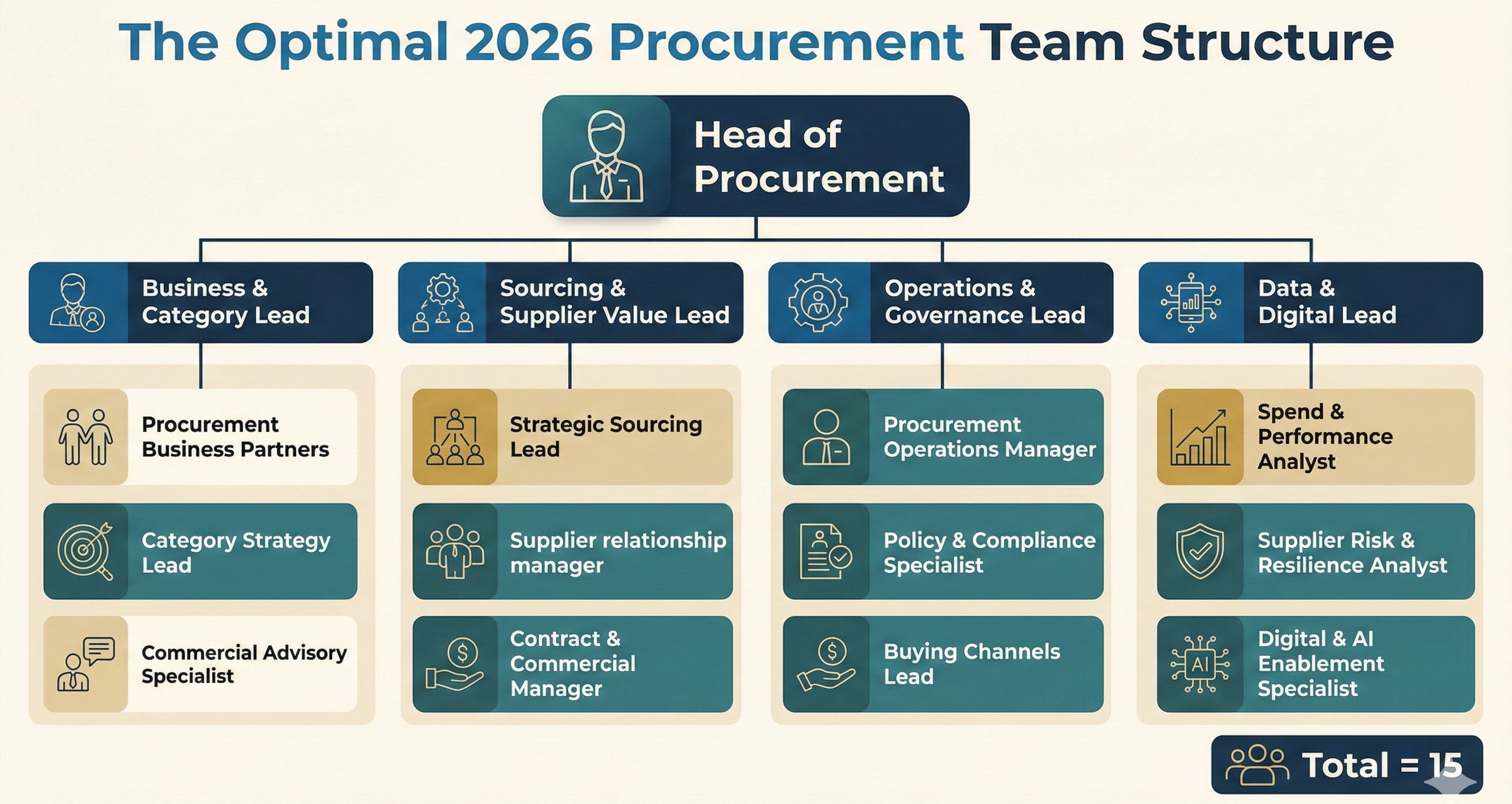
What does the ideal procurement team look like in 2026? One veteran procurement leader proposed an answer, and the response revealed just how much the profession is wrestling with fundamental questions about structure, headcount, and the changing nature of the work itself.
Tom Mills, who advises procurement professionals, laid out a 10 to 15 person team structure built around four pillars: business alignment, supplier value, operations and governance, and data and digital enablement.
The framework triggered intense discussion about whether such teams are realistic, how roles should be combined or separated, and whether certain functions belong in procurement at all.
The Proposed Structure
Mills organized his ideal team under a Head of Procurement who owns vision, executive alignment, enterprise risk, and the overall value narrative. Four leads report directly to this role.
The Business and Category Lead manages a team of three to four, including Procurement Business Partners embedded with key business units, a Category Strategy Lead owning top spend categories, and an optional Commercial Advisory Specialist for complex negotiations.
The Sourcing and Supplier Value Lead oversees strategic sourcing managers who run complex sourcing events, a Supplier Relationship Manager focused on performance and innovation, and an optional Contract and Commercial Manager for post-award value protection.
The Operations and Governance Lead handles process design, user experience, policy, compliance, and transactional buying through a team of two to three.
The Data and Digital Lead provides insight and enablement through spend analysts, risk and resilience analysts, and an optional Digital and AI Enablement Specialist.
Mills summarized his rationale: “Clear ownership by outcome. Senior roles, not junior layers. Automation absorbs admin. Business partners carry influence. Data supports judgement, not replaces it.”
The Headcount Reality Check
The first question from practitioners: is this realistic?
Brajan Gatys, who builds procurement functions at Personio, asked what many were thinking. “Is anyone here really getting that much headcount?”
Colin Bell, Group Director of Procurement at Quotient Sciences, pressed for specifics. “What size business or spend would be needed to support this structure? How would you scale it down to support SMEs?”
Thomas Bélanger offered a pointed observation. “It’s great! Now you just need a 3 billion dollar company to hire it!”
Mills clarified his assumptions. The model targets mid to large single-region businesses with annual revenue between £300 million and £1.5 billion, external third-party spend of £150 million to £700 million, limited geographic complexity, and procurement maturity beyond basic sourcing and P2P.
Felipe Solano ran the numbers. “It’s a structure of around £200-250k per year in salaries, plus bonuses, and should be operating in an organisation far above £100m turnover with a profitable stable 12-15% as minimum.”
Tahj B., a Director of Procurement who worked at Boeing, raised practical concerns. “I feel it would take years in most organizations to sell amongst the board. Even during my time at Boeing, it was lean.”
The Role Overlap Debate
Several experienced practitioners questioned whether certain roles should be separate at all.
Brian W. Lee, an AVP of Procurement, challenged the separation between category management and strategic sourcing. “For you to effectively execute contractual arrangements, you need to understand the business and objectives really well. I feel like having two separate pillars will just create a broken telephone between the two teams. I’d rather each category manager own and lead the end-to-end aspect.”
Lily Zhang, a global sourcing and procurement leader, identified a common problem. “One thing that often stands out in practice is the natural overlap between category strategy, strategic sourcing, and supplier relationship management. These roles can add a lot of value, but only when responsibilities are clearly segmented by spend, risk, or strategic importance. Otherwise, the same decisions end up being revisited across multiple layers, slowing execution and diluting accountability.”
Tomi Pesonen, a procurement advisor, suggested an alternative. “I would combine 1 and 2 and possibly combine roles pending on the scope of a business being partnered with.”
Should Compliance Report to Procurement?
James Meads, a procurement content creator and consultant, raised what he called “a controversial opinion.” He argued that Policy and Compliance should report to Finance or Internal Audit, not Procurement.
“If we’re truly going to be seen as an entrepreneurial and value-driven function, we have to shed this as a reporting line,” he wrote.
Natalia Pilipchak, a process design specialist, expanded on the conflict of interest concern. “Performance analysis of the procurement function may indeed be healthier outside of Procurement. When the same function both defines success metrics and is evaluated against them, especially where bonuses are involved, conflicts of interest are almost inevitable.”
She questioned Mills’ grouping of governance with transactional procurement. “I would be more inclined to combine governance with the data and digital pillar. Governance is about rules, and data is about the evidence of execution, real user experience and trends.”
Is Digital Enablement Still Optional?
Joël Collin-Demers, who mentors procurement teams on digital transformation, pushed back on one aspect of the structure. “I don’t know if the ‘Digital Enablement Lead’ is optional anymore though, at least in Enterprise.”
Gustavo Mattos Santos, a global operations executive, asked where AI execution fits. Mills responded that the Data and Digital lead would champion AI, but added, “I also think every part of the procurement function should be focusing on AI and how it will augment their roles.”
Kartik Shankar, a global procurement and transformation leader, predicted what comes next. “The agentic organisation to expand in 2027, I guess.”
What Works About the Framework
Despite the debates, several practitioners praised the structure’s clarity and outcome-focus.
Sascha Walleser appreciated how the model reflects reality. “I like this because it reflects how procurement actually works under pressure, not how org charts are usually drawn nicely. The clear separation between value creation, governance, and enablement is what makes it effective for me.”
He endorsed the emphasis on seniority. “Experienced people close to the business and suppliers make faster and better decisions. And keeping data and digital in a supporting role is key. Insight should sharpen judgement, not replace it.”
Steven Cox, a Chief Procurement Officer, emphasized that structure must follow strategy. “Any business questioning their structure, struggling to implement a strategy or deliver value realisation, should take a step back and do an E2E maturity audit which then provides the perfect context and justification to build the Org structure.”
Scaling Down for Smaller Organizations
Vamsi Krishna Velaga offered a practical starting point for smaller teams. “In small or early stage environments this level of specialisation isn’t always practical and teams often end up multitasking across sourcing, supplier management, compliance and data.”
He proposed a lean three-role model: “A Procurement Lead, a combined Sourcing and Supplier Manager, and an Operations or Compliance Coordinator. This ensures end-to-end coverage while still allowing the organisation to scale into your full 2026 structure.”
Mathew Schulz, founder of Pennywurth, noted that modern tools are changing what’s possible. “We’re in a time and place where organizations are looking for top tier talent who have the ability to build leveraging modern tools and new operating models. Both require rethinking how the work gets done.”
The Bigger Question
Ron Warneke, a strategic sourcing manager, offered perhaps the most pragmatic guidance. “So long as you align your organization to the Procurement Lifecycle you’ll be fine. Each organization has its own unique strategy.”
Domenico Tigani, Head of Global Indirect Procurement at Alfasigma, reminded readers that context determines structure. “It would be better to clarify that the structure depends on several factors, such as geographic coverage, company complexity, level of digitalization, team maturity, type of categories, and overall spend.”
The debate reveals a profession in transition. Automation is absorbing administrative work. AI is changing what’s possible with smaller teams. Business partnership is becoming essential. Yet headcount remains constrained, and executives still question whether specialized roles justify their cost.
Mills’ framework offers a target to aim for. The conversation it sparked shows how much ground procurement leaders must cover to get there.
Continue the discussion with procurement and supply chain professionals on Chain.NET.