

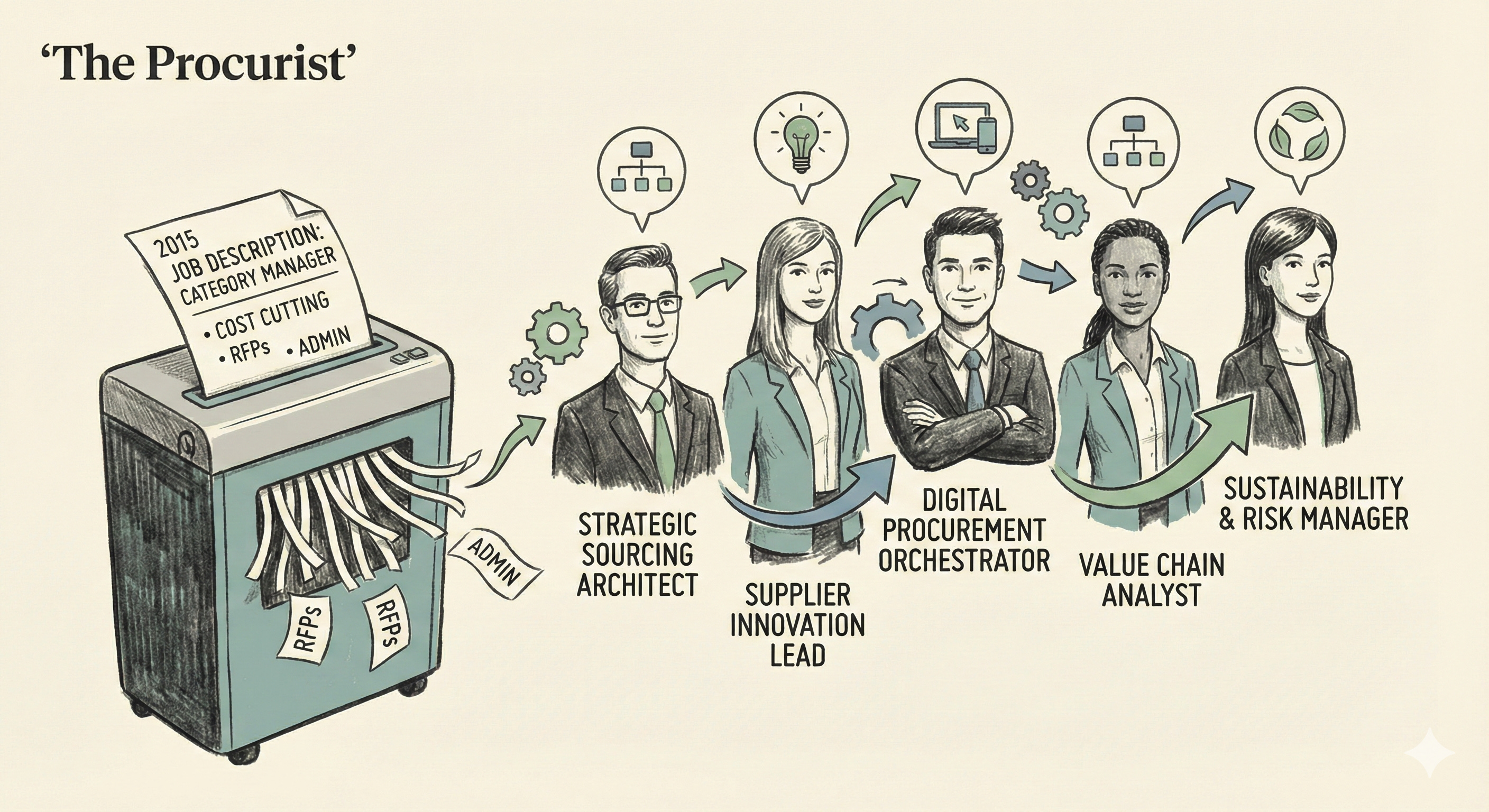
The traditional category manager may be heading for obsolescence. That’s the argument sparking intense debate among procurement professionals, with many agreeing that job descriptions have failed to keep pace with how the function actually needs to operate.
James Meads, a procurement consultant, ignited the conversation with a pointed critique of current hiring practices. “We’ve spent too long obsessing over savings, risk aversion, and compliance,” he wrote. “But the future will demand a totally different toolkit and mindset.”
His assessment struck a nerve. Dozens of procurement leaders weighed in, many confirming that job postings still reflect priorities from a decade ago.
The Problem with Today’s Job Descriptions
Meads argues that companies continue hiring for tasks that add diminishing value. Sending out 50-page RFPs. Creating category strategy slide decks that no one reads after the initial review. Following rigid sourcing processes that don’t match how businesses actually make decisions.
“I look at where things are heading, and all I see are job descriptions harking back to 2015,” he wrote.
Marijn Overvest, who runs a procurement training company, agreed. “You capture perfectly how far the profession has evolved and how slowly job descriptions follow.”
Meads responded with urgency. “I just hope hiring managers wake up before their teams become irrelevant.”
John Coyne, who helps industrial teams improve sourcing velocity, put it bluntly. “The next procurement org won’t be built around cost centers and compliance. It’ll be a velocity engine. Time-to-decision, not time-in-seat, is the new ROI. Anyone still hiring for 2015 will get lapped.”
Five Roles That Could Define the Next Decade
Meads proposed five roles he believes will shape procurement’s future:
1. Builders. People who create solutions rather than implement bloated software that takes a year to deploy.
2. Directors of Agentic Operations. Leaders who manage the AI agents that will handle operational work.
3. Agility Champions. Professionals focused on speed and flexibility rather than bureaucracy.
4. Internal Comms Managers. Specialists who translate procurement language into terms the business understands and values.
5. Entrepreneurs in Residence. Innovators who challenge conventional thinking and push back against default approaches.
The proposals generated strong reactions. Some practitioners are already building toward this vision.
Robert Nichol Jr., a procurement automation expert, said three of these roles should merge into one position. “I would LOVE to pioneer: Director of Agentic Procurement,” he wrote. The role would cover end-to-end vendor management, procurement operations, internal and external communications, project management, RFP management, first-pass contract review, and risk monitoring.
“I’ve already built 75% of these automations and maintained them,” Nichol added. “Being given the remit to take them agentic would be NEXT LEVEL exciting.”
Dr. Muddassir Ahmed, founder of SCMDOJO, expressed enthusiasm for the concept. “I like Director of Agentic Operations!”
The Business Partner Role Gets Strong Support
Among the proposed roles, one emerged as a clear favorite: the Procurement Business Partner.
Davinia Watson, who holds this title, offered a passionate endorsement. “Having worked as a Procurement Business Partner for several years, I’m still amazed that more procurement functions haven’t adopted this model. The BP role is truly pivotal. It creates real value by acting as an extension of the business, understanding priorities, aligning strategies, and shaping solutions that drive outcomes.”
She added, “Out of my entire procurement career, it’s been my favourite role.”
Tanya W., a senior procurement transformation advisor, noted she has had business partners in her teams for 15 years. Others confirmed the role exists but remains underutilized.
Khaldoun Abbas, founder of a procurement consultancy, said he would prioritize this role first. “It’ll be needed more than ever to orchestrate business needs, turn them into wins, and align Procurement’s key pillars with those evolving needs.”
Nicholas Ponzo, Vice President of Procurement Operations at MSCI, agreed. “This is a key element to shift from a reactive to proactive procurement org, which I believe is the first step in transformation.”
Meads predicted the role will spread beyond large organizations. “My prediction is that we’ll start to see it in smaller teams too, as they realise that a business-facing rather than supplier-facing team member is a valued addition to their structure.”
Not Everyone Agrees on the Approach
Felipe Solano, a procurement manager in the food industry, raised a practical concern. Are these five roles already part of what mid-level and senior procurement professionals should manage?
“Procurement and its real purpose is yet to be well defined, implemented and established at the vast majority of small and medium organisations,” he wrote. He pointed to a gap between expert visions of where procurement should head and the reality of what companies actually hire for.
Meads pushed back. “If Category Managers or Sourcing Managers are expected to do this as part of their role, then organisations will always be mediocre at best. You need to specialise.”
He cited Adam Smith’s division of labor principle from The Wealth of Nations. “Most procurement folks are not strong communicators or experts in automation. And, in fairness, they never needed to be. They were taught to follow process and err on the side of caution. It doesn’t work any more in today’s economy.”
Thomas Steinmetz, a transformation leader, offered a different perspective. “Not sure extinct is the right word. Evolution is to me more appropriate.” He questioned whether AI governance should be a procurement-specific role. “Procurement is part of end-to-end processes and making this into an isolated role does to me not bring the potential value.”
The AI Factor Changes Everything
Several commenters highlighted how artificial intelligence accelerates the need for new roles.
Asmaa Gad, who specializes in AI for procurement and supply chain, described the shift underway. “The shift from process guardians to orchestrators of AI-enabled operations is already underway. The teams that embrace these new roles will move faster than the ones still optimizing 50-page RFPs.”
Faiq Ali, who works on procurement digital transformation, emphasized the capability question. “Procurement roles will evolve fastest where leaders prioritise capability that translates intelligence into outcomes rather than repeating traditional category routines.”
Radha R., a global strategic sourcing leader, pointed to supplier relationship management as a function being transformed by AI. “With AI now enabling deeper insights into strategic spend and analytics, SRM is evolving into a critical backbone of the enterprise. It anchors risk management, governance, and resilience.”
Meads agreed that related functions will consolidate. “I believe SRM, CLM and VLM will all merge into one role to give that holistic, end-to-end view of both supplier and contract performance.”
What This Means for Hiring Managers
The debate reveals a profession at an inflection point. Traditional job descriptions emphasize process compliance and cost savings. The emerging vision centers on speed, business alignment, and AI orchestration.
Socrates C T summarized the shift well. “Looks less like replacing procurement and more like upgrading it to ‘enterprise value edition.’”
For companies still posting category manager roles with 2015-era requirements, the message from practitioners is clear: the talent you need may not apply for jobs that sound outdated.
Edward Murphy, founder and CEO of FactorySpec, endorsed the entrepreneur concept. “Love the entrepreneur role. A must in every department if you ask me.”
Meads sees early movers gaining significant advantage. Better talent attraction. Higher retention of top performers. Several times more productivity from existing team sizes.
The question he leaves with hiring managers: which of these five roles would you hire first?
Join the conversation with procurement and supply chain professionals on Chain.NET. For AI tools designed specifically for the industry, visit Chaine.AI.