

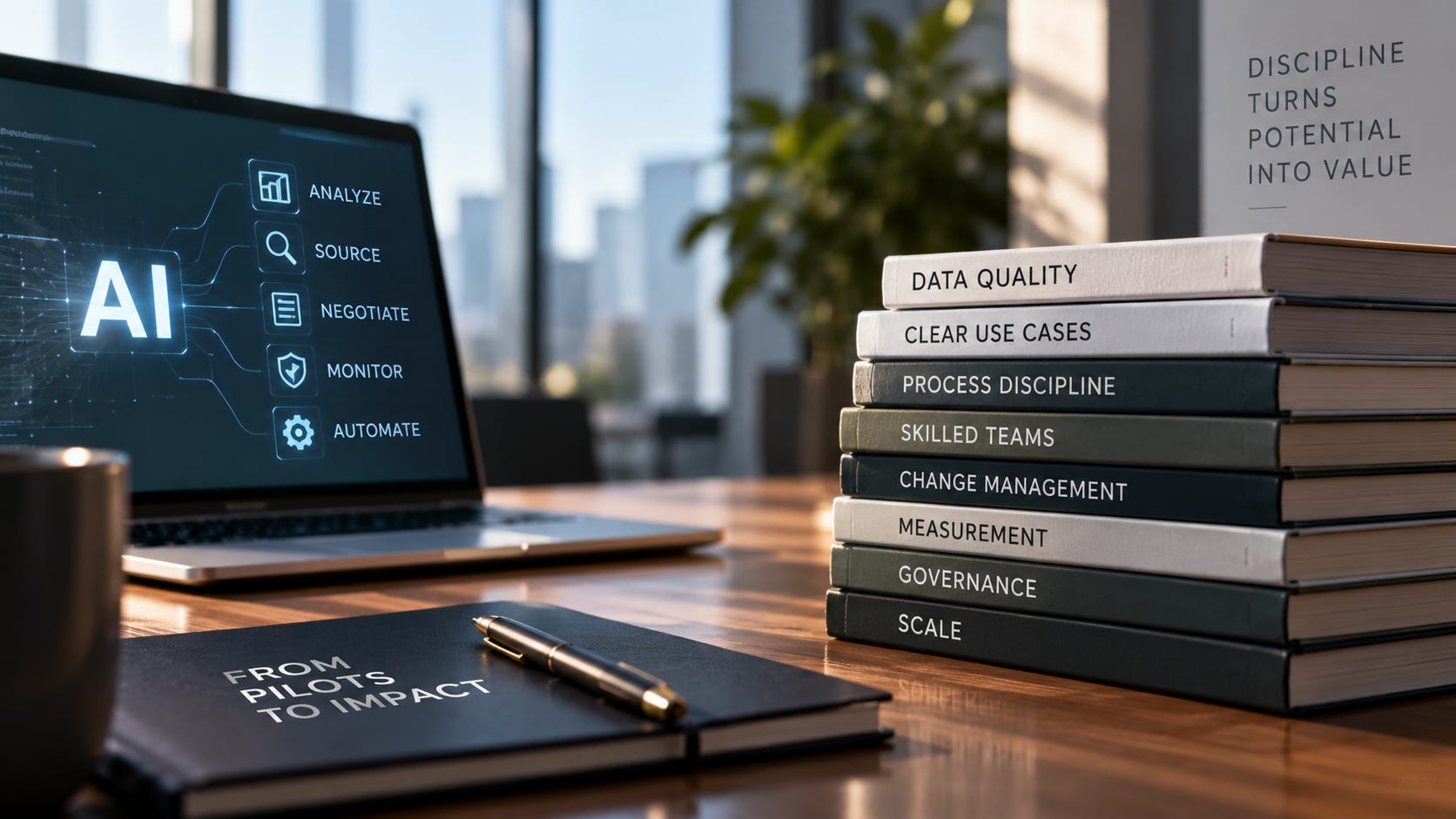
AI is already rewriting procurement work. Spend analytics, supplier discovery, contract review, risk monitoring, and negotiation preparation are all being reshaped. Yet across enterprises, the same pattern keeps showing up. Teams buy the tool, run the pilot, and discover that AI did not solve the problem. It exposed one.
That gap framed a GSCC Executive Roundtable with procurement and supply chain leaders from HSBC, ACWA Power, Dell Technologies, GE HealthCare, and Domino’s. Their conclusion was consistent. The bottleneck is not the technology. It is the operating discipline underneath it.
AI does not fix fragmentation. It accelerates it.
Ankit Kulkarni, Head of Inventory Systems and Supply Chain Performance at ACWA Power, put it plainly. Procurement is not primarily behind on AI. It is behind on the operating discipline needed to use AI reliably.
No model compensates for fragmented supplier records, inconsistent taxonomies, or unclear process ownership. He has seen the gaps directly in master data, commodity mappings, specifications, and critical spare planning. AI can interpret language and find patterns at a scale humans cannot match manually. But if the source is incomplete and nobody owns the exceptions, it simply produces a faster version of existing uncertainty.
Ujjwala Mishra, OM Leader for India and South Asia at GE HealthCare, made the same point from a different angle. AI should not be a layer sitting on top of procurement. If the systems underneath are fragmented, the result is garbage in, garbage out. AI should remove layers, not add one.
Sandeep Sharma, Director of Group Procurement and Supply Chain at Domino’s, raised the data-history problem. Machine learning often needs two and a half to three years of data before inferences become reliable. He also questioned whether cross-functional data exists at all. If a procurement spike is caused by a marketing promotion, is that relationship even visible to the model?
Two kinds of maturity
Ajaay Kapur, VP and Head of Procurement at HSBC Group, argued that data, skills, and governance are subsets of a larger issue. What matters first is the ecosystem. That is a top management decision about direction, followed by a deliberate effort to identify manual and non-value-adding processes across functions.
At HSBC, that shows up structurally. Risk owns AI governance. IT owns adoption and tool selection, working with the business on requirements. Procurement owns the process. The organization also signed an agreement with LinkedIn requiring employees to complete 30 to 40 hours of AI training with certification attached.
Mishra summarized the requirement as two maturities working together. Digital maturity gives you connected data, platforms, and technology. Enterprise maturity gives you standardized processes, governance, ownership, and capability. AI readiness depends on both.
Kim Beng Chan of Dell Technologies added a practical note about scale. Many SMEs simply do not have the data yet, because years of records still sit in hard copy in a warehouse. Digitizing comes first, then data hygiene, then governance, then security. Enterprises can fund data scientists and architects to run that. Smaller firms cannot assume the same starting line.
Where to actually start
The panel converged on a narrow-scope approach.
Kulkarni laid out three foundations. Start with a small bounded domain and one specific decision area rather than an enterprise-wide data program. Define a common language, meaning agreed identifiers, category and commodity structures, critical definitions, ownership, and basic quality rules. Then assign a business owner to every critical field and exception, because AI will never own an unresolved gap or a conflicting business rule. The third foundation is a repeatable exception process that distinguishes valid results from low-confidence recommendations and missing evidence, with a defined reviewer for each route.
Sandeep Sharma stressed sequencing and honesty about returns. Pick the highest-priority function where backups exist and ROI is clearest. In his experience, AI does not deliver ROI inside 24 months, and during implementation the human brain still carries roughly 60% of the load against AI’s 40%.
Asked how clean the data must be before starting, Mishra offered the most useful reframe of the session. There is never a perfect moment. Take a contract renewal covering 500 suppliers with inconsistent payment terms, messy descriptions, and missing fields. The instinct is to declare the organization not ready. Instead, decide what you want to improve, such as expiry dates, categories, and commercial terms. Let AI surface the 20 contracts that need urgent attention, then clean outward from there.
Kapur described the same logic through a PeopleSoft to Oracle migration, where AI helped identify duplicate supplier records registered under name variants before the data moved.
Who owns it, and who checks it
On ownership, Kulkarni drew a clean line. Procurement defines the process and the objective. IT owns the data architecture and cybersecurity. IT does not decide what gets verified as an exception. When procurement and IT disagreed at his organization, the resolution came through a business case with quantified outcomes and minimal spend, since the solution was built in house rather than purchased.
Kapur described a handover model borrowed from automotive, where a new-model team passes a matured process to mass procurement. Once his Oracle Fusion implementation stabilized, procurement handed operations to IT so the function could move to the next project.
On blind trust, Mishra gave the sharpest example. AI may recommend a supplier based on a flawless delivery history. The buyer knows that supplier just had a fire at its plant. AI will never surface that. Use AI as a copilot, never on autopilot.
Takeaways for procurement leaders
Learn AI architecture, not prompting. Kulkarni’s strongest advice was that copying and pasting data into ChatGPT or Copilot is not AI adoption. He built spend classification for 200,000 line items in house using Python connected to Azure OpenAI, plus a semantic and lexical matching model that found duplicate master data across 111 assets in 16 countries. Commercial equivalents run into six figures.
Fix the process before you automate it. Asked how to repair broken processes without a two-year project, Kulkarni recommended bringing an operational excellence expert alongside management. Mishra offered a lighter alternative for teams without one: value stream mapping. Map the steps, find where the process breaks, then iterate.
Where is your procurement data weakest, and what would you have to fix before you trusted an AI recommendation in a sourcing decision?
Share your view in the comments. Continue the discussion on Chain.NET, the global supply chain community, at https://www.chain.net/c/ask. Ask questions, join the next Executive Roundtable, and access exclusive resources. Membership benefits are listed at https://gscc.co/benefits.