

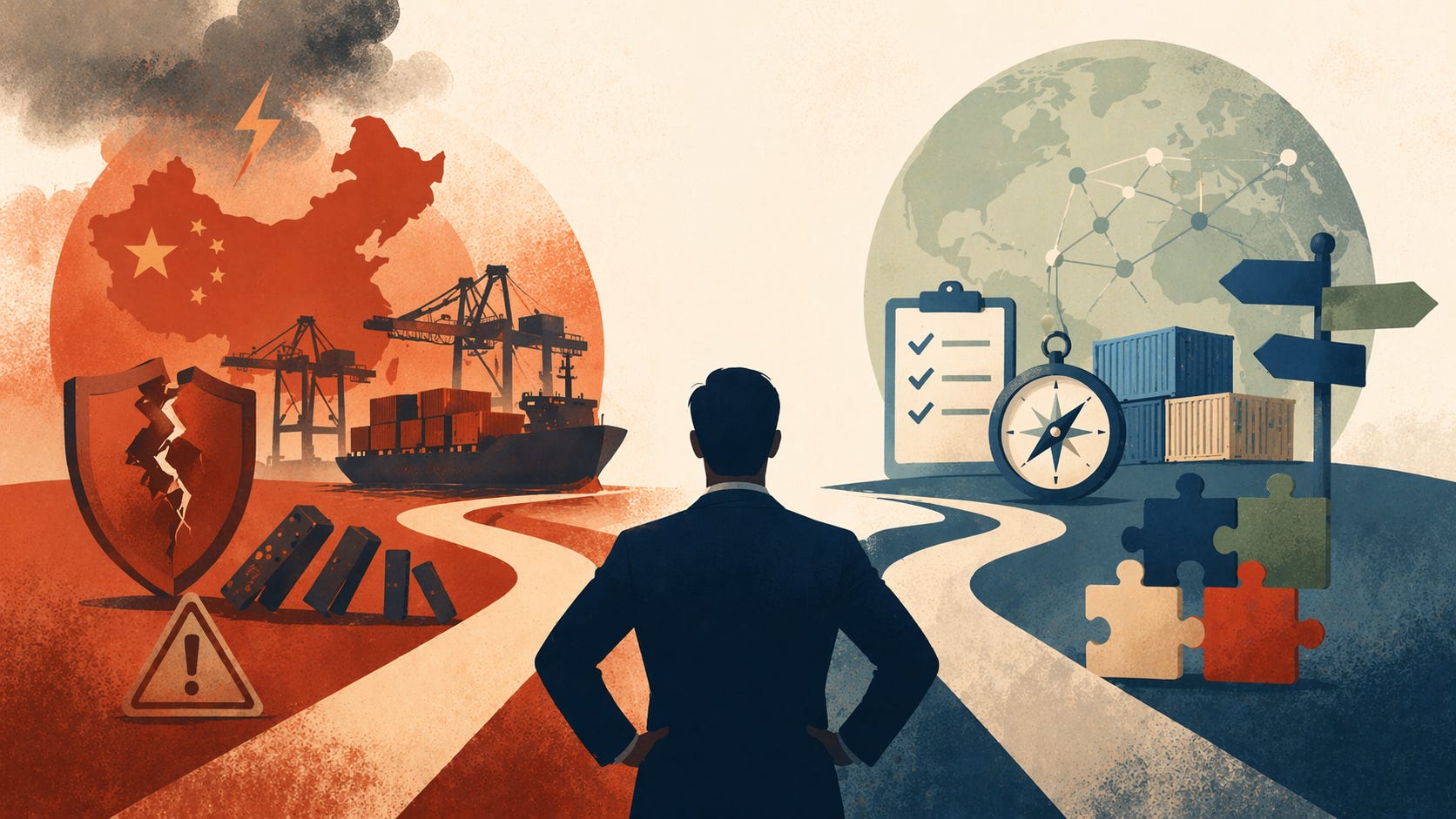
A year ago, China sourcing was a risk management conversation. In 2026, for many industries, it has become a crisis management conversation.
That’s the assessment from Ugo Flumian, a Chief Procurement Officer who has been tracking the structural forces reshaping global sourcing decisions. His analysis has sparked debate among procurement leaders about how to navigate what has become one of the most complex sourcing environments in decades.
“Five structural forces have landed simultaneously, and they are reshaping the equation,” Flumian wrote, outlining the convergence that has transformed procurement strategy.
The Five Forces
CBAM is live. The Carbon Border Adjustment Mechanism took effect January 1st. This is not a future threat but a present cost. For Chinese steel and aluminium, analysts are already tracking 15-20% increases in total landed cost. Expansion to chemicals and plastics is already on the legislative roadmap.
China has weaponised critical minerals. Gallium, germanium, graphite, tungsten: export controls imposed in successive packages through 2024-2025. Companies that have not yet developed alternative sources are operating in a structurally fragile position.
Tariff unpredictability is now structural. Annual procurement cycles can no longer keep pace with the speed of regulatory change. The most advanced companies are shortening contract durations and keeping alternative suppliers qualified even when not immediately using them.
Chinese overcapacity is a strategic trap. Lower prices today equal deeper dependency tomorrow. Companies that hollow out their European supply base chasing Chinese deflation will face an expensive rebuilding exercise when the next disruption arrives. And the next disruption is not a question of if.
The Atlantic fracture complicates everything. Europe is navigating between US economic coercion and Chinese strategic competition. The practical implication: every category now requires a different answer, “strategic” or “commercial,” with entirely different regulatory and board-level implications.
Not All Categories Are Equal
Pierre Courtemanche, a sustainability and supply chain strategist, highlighted a critical shift in how companies must think about the China question.
“The China question is no longer a country-level decision. It’s becoming a product and material-level decision,” Courtemanche observed. “Two products sourced from China can carry completely different risk profiles depending on upstream materials, export controls, carbon exposure under the Carbon Border Adjustment Mechanism, or regulatory pressure.”
His reframe: “The real question is no longer ‘China or not China?’ It’s ‘which inputs, with what risk, and with which alternative ready?’”
Flumian’s category-by-category breakdown reveals the nuance required in 2026:
Potential Exit, Critical: Sensors and IP-sensitive power electronics carry potential risk of IP leakage from Chinese manufacturing partners. Companies need to carefully evaluate how sensitive the technology is for finished products and weight European or Japanese alternatives’ landed cost on the finished bill of materials.
Near-Shore, Urgent: Aluminium diecasting math has changed under CBAM. Chinese aluminium production remains heavily coal-powered. European and Turkish foundries, predominantly electric arc furnace-based, now can have a structural cost advantage once CBAM is included in the total landed cost model. For sheet metal and machining, steel CBAM plus lead time plus cost of capital on in-transit inventory means Eastern Europe can become competitive again in some cases.
China+1, Qualify Now: PCBA presents a mixed picture. China’s dominance at ecosystem level remains intact, but semiconductor export controls are creating lead time unpredictability on advanced chips. For complex, IP-sensitive PCBA, the case for European qualification has become stronger. For high-volume commodity assemblies, China with Vietnamese contingency remains rational.
Electrical motors require particular attention. “Watch the hidden rare earth dependency,” Flumian warned. “Motors ‘assembled in India or Eastern Europe’ often use Chinese-sourced NdFeB magnets. True resilience requires tracing rare earth content back to origin.”
Stay, But Rebuild Your Cost Model: Structural steel, plastic injection, and commodity PCBA still show real Chinese advantage, but cost models need updating. Anti-dumping duties, Corporate Sustainability Due Diligence Directive compliance, and in-transit inventory cost of capital all change the equation.
The Ecosystem Challenge
Wil Liew, who specializes in cross-regional tooling and manufacturing execution, offered a practical perspective on the ground reality.
“In practice, what we often see is that companies are not really replacing China, but rebalancing sourcing risk,” Liew observed.
He identified the core challenge many companies face. “China still offers unmatched speed in tooling development and engineering iterations. The challenge for many companies is not leaving China, but replicating its manufacturing ecosystem elsewhere.”
This ecosystem advantage explains why wholesale exits from China remain rare despite the mounting pressures. The infrastructure, supplier density, engineering capabilities, and speed that China offers took decades to build and cannot be replicated quickly elsewhere.
The Cultural Dimension
Roberto Cavani, a founder and CEO with Chinese business experience dating to 1998, offered a reminder about perspective.
“Don’t look at China with European eyes,” Cavani cautioned. “To understand China in depth you need to look at China with Chinese eyes.”
The comment underscores a tension in the current debate. While structural forces are undeniably reshaping the sourcing equation, understanding how China will respond, adapt, and compete requires more than spreadsheet analysis. Companies that have built deep relationships and cultural understanding in China over decades face different calculations than those treating it purely as a commodity sourcing decision.
The Real Landed Cost
Flumian’s central message cuts through the complexity: “Stop comparing ex-works prices. The real landed cost in 2026 includes CBAM, compliance cost, geopolitical risk premium, and cost of capital.”
When everything is modeled, he argues, the Chinese advantage is narrower than procurement dashboards suggest.
This represents a fundamental shift in how procurement teams must operate. The traditional approach of comparing supplier quotes and selecting the lowest price no longer captures the full picture. Total landed cost now includes:
Carbon costs under CBAM that penalize coal-powered manufacturing. Compliance costs for sustainability due diligence requirements. Geopolitical risk premiums for supply chain fragility. Cost of capital tied up in longer lead times and in-transit inventory. Qualification costs for maintaining alternative suppliers even when not actively using them.
The Strategic Framework
Don XU, a procurement head with over 20 years of experience, described Flumian’s analysis as a “very realistic view,” reflecting the sentiment of practitioners navigating these challenges daily.
The framework emerging from this discussion suggests three levels of decision-making:
Category-level assessment: Not all products carry the same risk. Sensors require different treatment than commodity plastics. IP sensitivity, carbon exposure, and critical mineral content all factor into categorization.
Alternative readiness: The most advanced companies are qualifying alternative suppliers even when not immediately using them. Contract durations are shortening. Flexibility is being built into procurement structures.
Total cost modeling: Ex-works prices are no longer sufficient. Every procurement decision now requires modeling CBAM impact, compliance requirements, geopolitical risk, and capital costs.
What Comes Next
The procurement leaders engaging with this analysis are not debating whether China sourcing has changed. They’re debating how to respond.
Some categories will exit China entirely where IP sensitivity or regulatory pressure makes continued sourcing untenable. Others will near-shore urgently as CBAM transforms the competitive equation. Many will pursue China+1 strategies, maintaining Chinese suppliers while qualifying alternatives. And some will stay, but with completely rebuilt cost models that reflect the true 2026 reality.
The companies that will navigate this best are those that have moved beyond binary thinking. The question is not China or not China. It’s which category, with what risk profile, with what alternative ready.
As Flumian summarized: “The next disruption is not a question of if.”
The procurement teams that have already done the work, qualified the alternatives, rebuilt their cost models, and understood their category-level exposure will be positioned to respond. Those still comparing ex-works prices will find themselves in crisis management mode when the next shock arrives.
Continue the discussion with procurement and supply chain professionals on Chain.NET.